


At a recent Brightstar event, the AI in Clinical Practice conference, Sonny Taite, Director of HealthX, Health New Zealand’s clinician-led programme for scaling digital and AI tools shared the journey to bring cutting-edge AI technologies into our public healthcare system, responding to rapid technological change in a way that is both deliberate and responsible.
Turning Challenge to opportunity: the ‘Monthly Constraint’
Modern healthcare is a clash of speeds: the dizzying, exponential growth of AI versus the deliberate, safety-first pace required in clinical environments. When HealthX was formed, the directive from the Health NZ Chief Executive, Dr Dale Bramley, and the Health Minister was daunting – deliver an impactful initiative every single month for six months.
Rather than viewing this as a roadblock, Taite’s lean team embraced it as a vital innovation constraint. A monthly deadline stops teams trying to tackle everything at once. Instead, it focuses effort on practical, high-impact initiatives that can be tested, scaled, and built on over time.
To proceed, an idea or initiative must satisfy six key criteria:
- Be clinician-led, with a named clinical champion
- Have the potential to scale nationally
- Be feasible to scale, including fitting within available budgets
- Demonstrate sufficient impact, assessed on a case-by-case basis
- Contribute to one or more of Health New Zealand’s five national health targets
- Be a digital or AI-enabled technology
All initiatives also undergo formal clinical governance, privacy, and assurance processes before scaling. This monthly cadence builds an organic “trust ladder.” It also allows solutions to be quickly iterated and limitations / gaps to be noted at the pilot stage. To maintain the reach and breadth of involvement as they expand, HealthX recently launched a Clinical Advisory Group featuring a network of 35 clinicians nationwide.
Rapid pilots, Outsized impacts
The initiatives look to target any of three pressure areas: workforce pressure, rural/remote access, and clinical efficiencies. Some of the initiatives HealthX has introduced include –
• AI Scribes (September 2025): Ambient artificial intelligence scribe to draft clinical documents. This initiative has expanded beyond initial deployment to only Emergency Departments and now is available to 2,500 frontline staff across Emergency Departments and Outpatient mental health teams, with an approved vendor panel being established and service design underway to embed AI scribe as a supported Health New Zealand service. Early reports from clinicians at Middlemore indicate self-reported improvements in documentation, increased number of patients seen per shift and positive impacts on clinician wellbeing.
• Remote Patient Monitoring (October 2025): Implemented for heart failure monitoring in remote areas like Kaitāia. Traditionally, finding the right medication balance for a patient could take five to six months. Early evaluation indicates that, with the new data-driven remote monitoring approach, hospital admissions during treatment up-titration have reduced from around 47 percent to 12 percent, and patients are reaching target treatment doses significantly faster than standard care. Access to real-time data also allows patient check-ins to be redirected seamlessly to other available specialists when the original clinician is absent or on leave.
More people needed in healthcare, not less – AI as a workforce multiplier
A central pillar of the HealthX philosophy is reframing AI from a perceived risk into an asset. On workforce impacts, Sonny challenges the idea that AI will replace healthcare workers, instead describing it as a “workforce multiplier”:
“AI is a workforce multiplier. In health, the focus has always been on making the best use of our people. AI helps support clinicians to work more effectively – it doesn’t replace the need for clinical judgement.”
While technology will continue to evolve, HealthX’s focus is on using AI to support and strengthen the workforce, ensuring clinicians remain central to care.
Direct advice for leaders: Roll up your sleeves
When overcoming systemic barriers, HealthX has found strong support from both patients and clinicians. The main challenge lies in navigating the complexity of existing systems and processes, which are often operating at full capacity. Addressing this requires more than passive commentary – it calls for active, hands-on engagement from leaders to work through these challenges in practice.
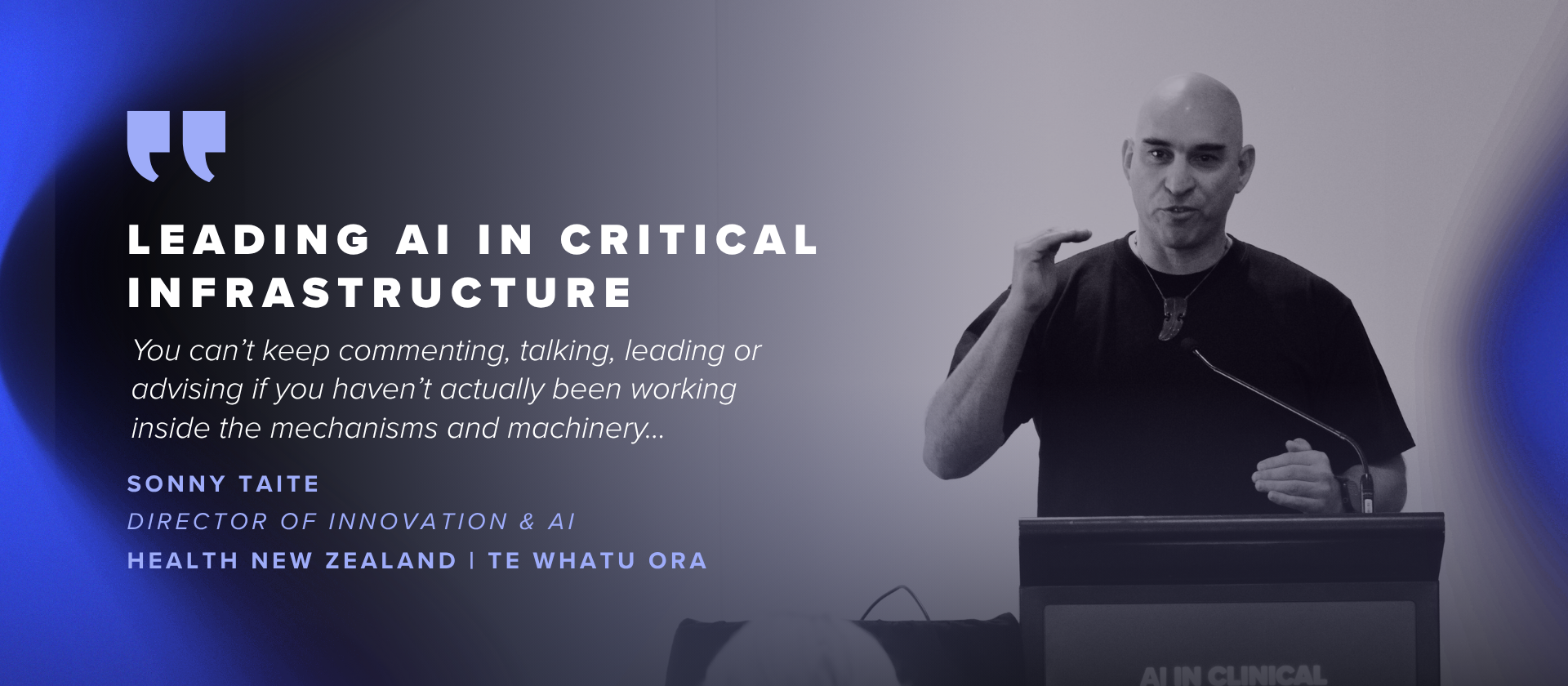
“You can’t keep commenting, talking, leading or advising on this if you haven’t actually been working inside the mechanisms and machinery… You need to use it — and really use it.”
True leadership requires a deeper level of technical understanding. Leaders need to move beyond simply asking questions and receiving answers, and instead actively engage with how these technologies work in practice. This means taking the time to “roll up their sleeves” and understand the mechanics and limitations of frontier models.
Sonny exemplified this through hands-on engagement – personally testing the frontier limits over seven weeks, building nine apps, creating a virtual “AI team” to run experiments and inform strategy, and logging a rolling monthly average usage of 13.6 million tokens.